
From 8 to 1,600: The Story Behind the National Expansion of our CSE Program across Madagascar

Updated: May 17

If you were a student at Rakotozafy Alphonse, Ambatovory, Idanda, or Mahazengy public middle schools back in 2013, you'd be one of the very few young people in Madagascar who had access to comprehensive sexuality education (CSE) led by Projet Jeune Leader educators.
At the time, our CSE program ran in just four public middle schools in the Haute Matsiatra region, delivered by a small team of eight specialized educators — young adults we recruited and trained ourselves. Year after year, we kept growing, adding a handful of partner schools at a time.
The impact was tangible. But it was a time- and resource-intensive growth pathway. We knew that to achieve our vision of reaching every young adolescent in Madagascar, we needed to build out a more ambitious scaling strategy.
Mainstreaming CSE into the public education system
Over the past decade, we have built and refined a model deeply rooted in Madagascar's rural public education system. We invited senior Ministry of Education officials to see our work firsthand in the field. We shared stories of change from the communities where we work. Gradually, key figures within the Ministry developed a genuine sense of ownership over this initiative, and began championing it from the inside.
From 8 CSE educators in 2013 to 1,600 this year, the scale-up is now underway. But we're getting ahead of ourselves — let's rewind!
Our original growth trajectory of adding a few new partner schools a year, through direct outreach and word-of-mouth, was effective for trust-building, but slow. Our model of recruiting and training young adults from the general public also created limitations. Each year, we recruited and trained a new cohort of CSE educators, a process that was highly labor-intensive (we would receive hundreds of applications for just a handful of spots…). Educators typically stayed with us for only one to three years and weren't always embedded in the communities they served — tremendous lost value.
Since we were already working within the public school system, it made sense to explore what deeper integration could look like to leverage existing structures and resources to extend our reach.
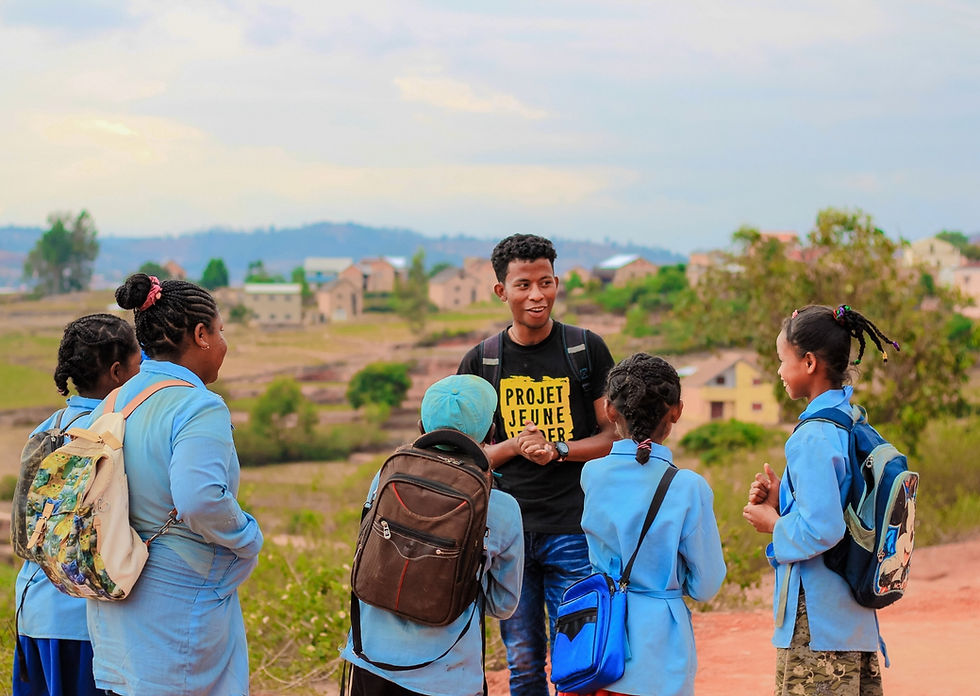
The first steps
In 2022, we took our first big step towards scaling up in partnership with government, launching a pilot model in the Haute Matsiatra region with the Ministry of Education.
It represented a significant shift in our delivery model. Rather than recruiting educators from the general public, we began training student teachers within the Haute Matsiatra public teacher training institute to deliver our CSE program alongside their main subject. We also put in place ongoing coaching, close supervision, and a rigorous quality monitoring system.

Over three years, we proved the model worked across the entire Haute Matsiatra region.
We kept adapting and refining as we went, with an eye towards continued scale-up. For instance, we updated our scripted curriculum to make it clearer and easier for teachers to use. We streamlined costs, cutting out almost all materials except for a few reusable visual teaching tools. And we deepened relationships with key Ministry stakeholders, inviting them to see the program in action and helping them understand our approach and our impact.
The leap
In early June 2025, we officially signed a new partnership with Madagascar's Ministry of Education. The government committed to funding the direct costs of national implementation, and entrusted Projet Jeune Leader with the technical support of training and supporting the teachers who would deliver our CSE program across the country.
It was a pivotal moment in PJL's journey, and a giant step toward realizing our scaling ambitions.
The work began immediately. Mamisoa and Chrys, our technical leads, and Mihaja, our monitoring and evaluation manager, hit the road — accompanied by a Ministry representative — to meet our new local partners.
"It's an opportunity to explain our CSE program and our vision directly to our new partners," explained Chrys. Shared Mihaja: "I find that in-person visits build the credibility and legitimacy of PJL and our program with new stakeholders." And for Mamisoa, it was also about listening: "It was a chance to better understand the different local contexts where the new Mpanabe JL teachers will be working."
Those first conversations gave us real momentum. A staff member from the Regional Directorate of National Education in the Vakinankaratra region said: "I really hope your activities expand to other districts beyond where you're already present, to spread across all of Madagascar."
Alongside these visits, former educators trained by PJL — with three years of experience under their belts — stepped up to become technical supervisors. They will train the new “Mpanabe JL” teachers and support them throughout the school year. We also trained veteran Mpanabe JL educators from the Haute Matsiatra region — the teachers who had already delivered the PJL program during our pilot — to assist the technical supervisors.
In January 2026, the first cohort of 485 teachers was trained. In April 2026, a second cohort of 1,115 followed. That's 1,600 teachers, trained and ready to deliver CSE across Madagascar.
This path hasn't been without its challenges. Cultural and dialectal diversity, the logistics of getting materials to hard-to-reach areas, phone and internet access issues in rural areas,... all have all tested us in the first months! But ambition and quality are values that run deep in this team, so we keep asking hard questions of ourselves and learning from every obstacle.
We'll be sharing more on the blog as we go. Stay tuned!


